
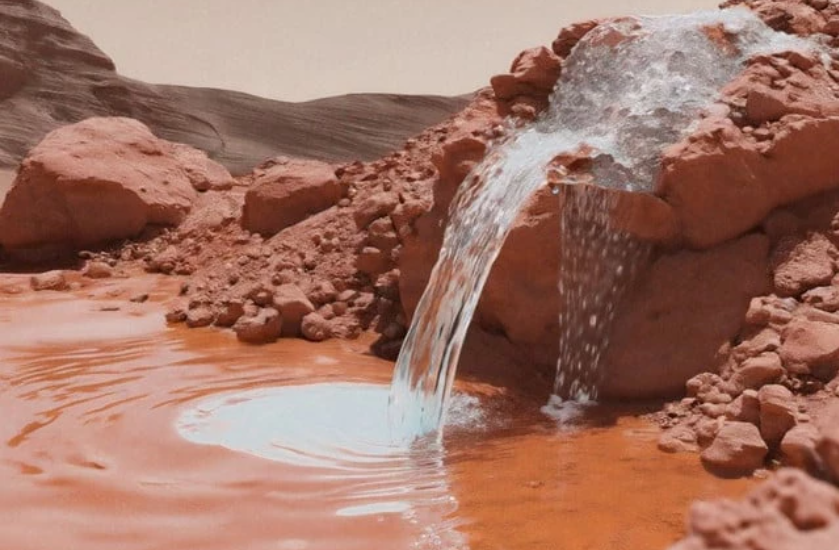
For decades, the Red Planet has captivated our imagination as a desolate, dusty world—a barren wasteland that seems light-years away from the blue marble we call home. But what if Mars wasn’t always this way? What if, billions of years ago, it was a warm, wet world crisscrossed by rivers and dotted with vast lakes, much like early Earth?
In a landmark discovery announced in March 2026, NASA’s Perseverance rover has done more than just hypothesize about this wet past. Using advanced ground-penetrating radar, the rover has uncovered the oldest direct evidence of water flowing on Mars, buried deep beneath the surface of Jezero Crater .
This finding pushes the timeline of potentially habitable conditions on Mars further back than ever before, offering profound implications for the search for extraterrestrial life. Let’s dive into how the rover made this discovery, why a buried “delta” is a game-changer, and what it means for the future of space exploration.
The Discovery: A Buried Time Capsule in Jezero Crater
We have known for a while that water once existed on Mars. Orbiters have spotted ancient riverbeds, and previous rovers found minerals that only form in water. However, this new evidence is different. It is not just on the surface; it is buried deep underground, preserved like a fossil.
How the Perseverance Rover Peered Beneath the Surface
Since landing in 2021, Perseverance has been exploring Jezero Crater, a 45-kilometer-wide basin that scientists believe once housed a giant lake . But the rover’s latest discovery didn’t come from scooping rocks or drilling into cliffs. It came from listening to echoes.
The rover utilized an instrument called RIMFAX (Radar Imager for Mars Subsurface Experiment) . Think of it as a high-tech flashlight that uses radio waves instead of light. As Perseverance drove 6.1 kilometers (3.8 miles) across the crater floor between September 2023 and February 2024, it fired radar pulses into the ground .
- Penetrating the Past: The radar waves bounced off rock layers up to 35 meters (115 feet) underground—nearly twice as deep as previous probes.
- Creating a 3D Map: By measuring the time it took for the echoes to return, scientists constructed a three-dimensional map of the buried landscape.
An Ancient Delta Older Than the Surface Itself
What did the radar see? Layered sediments arranged in sloping patterns that are unmistakably characteristic of a river delta .
A delta is a fan-shaped deposit of sediment that forms when a fast-moving river slows down as it enters a larger body of water, like a lake or ocean. On Earth, deltas are teeming with life and are excellent at preserving organic material.
The data revealed that beneath the recognizable surface features of Jezero (known as the Western Delta, dated to 3.5–3.7 billion years ago), there lies an even older, hidden delta system . Researchers estimate that this buried formation dates back to a staggering 3.7 to 4.2 billion years ago .
To put that in perspective, Mars formed about 4.5 billion years ago. This means that a mere 300 to 800 million years after the planet was born, it was already hosting a stable environment with flowing water.
Why “Oldest Evidence” Matters for the Search for Life
This discovery is not just a geological trophy; it is a major victory for astrobiology. The search for life on Mars is essentially a search for water—but not just any water. It is a search for sustained water.
Extending the Window for Habitability
Previously, the “wet period” of Mars was thought to be relatively brief. However, the presence of a delta dating back 4.2 billion years, predating the surface delta by hundreds of millions of years, suggests that Mars had multiple, long-lasting phases of flowing water .
- Why it matters: Life, as we know it, takes time to evolve. Even microbial life requires stable conditions to emerge. This discovery proves that Mars had the “right stuff”—a warmer climate and thicker atmosphere—for a much longer duration than previously estimated.
- The “Puzzle” Solved: Scientists were puzzled by certain mineral deposits (rich in carbonates and olivine) in the crater. The radar data now suggests these minerals were laid down by this ancient river system, confirming that water played a vital role in their formation .
A “Biosignature Preservation” Hotspot
UCLA planetary scientist Emily Cardarelli, lead author of the study published in Science Advances, noted that the environment was “capable of biosignature preservation” .
On Earth, river deltas are “niches favorable to microbial life.” They concentrate nutrients and bury organic matter quickly, protecting it from oxidation. The buried delta on Mars acts as a time capsule. If microbial life ever existed in those ancient waters, the evidence is likely still there, locked in the rock 35 meters beneath the rover’s wheels .
Key Takeaway: This buried delta is now a prime target for future sample return missions. The rocks here are the most likely to contain fossilized signs of ancient Martian microbes.
The Technology Behind the Triumph: RIMFAX
None of this would have been possible without the sophisticated toolkit aboard Perseverance.
Planetary Geology’s New Best Friend
Before rovers, we relied on orbital images. But orbital cameras can’t see through rock. RIMFAX changes the game entirely.
- Detailed Imaging: The instrument detected submeter-scale features, including cross-bedding and lobe structures, which are tell-tale signs of sediment settling out of moving water .
- Mapping the Unseen: By combining the radar data, scientists discovered that the Margin unit (the area where the rover drove) is up to 90 meters thick in some places. That represents an enormous volume of sediment, hinting at a powerful, long-lived river system .
Co-author David Paige of UCLA stated, “This further cements the notion that ground-penetrating radar is indeed an extremely valuable new tool for studying planetary geology” .
The Bigger Picture: A Wet Mars vs. The Dry Desert
This discovery adds to a growing pile of evidence that Mars was once a remarkably wet world.
- Previous Findings: Earlier missions found evidence of ancient oceans on the northern plains. China’s Zhurong rover also detected subsurface beaches from a potential ocean .
- Current Context: While we know water existed, scientists debate whether it was a brief, catastrophic flood or a long-term stable cycle. This new delta, with its layered, repeating patterns of erosion and deposition, strongly suggests the latter. It points to a hydrologically active Mars for hundreds of millions of years.
“Mars is diverse,” said Cardarelli, “and each rover mission reveals another piece of its puzzling past and the early development of our rocky neighbor” .
Conclusion: What Comes Next?
The discovery of the oldest evidence of water on Mars is a stunning reminder of how much we still have to learn about our celestial neighbor. It tells us that the Red Planet was once blue with water, and perhaps green with microbial life.
However, Perseverance is not done yet. The rover is currently climbing the rim of Jezero Crater to explore even older terrains beyond the ancient lakebed.
Actionable Insight for Enthusiasts:
- Follow the Mission: Keep an eye on NASA’s Eyes or the Perseverance mission log. The rover is heading toward the “Margin Unit” and “Crater Rim,” where more buried secrets await.
- The Sample Question: The biggest hurdle remains getting those drilled samples back to Earth. The Mars Sample Return mission is currently in a redesign phase, but the urgency to retrieve these 4.2-billion-year-old delta rocks has never been higher.
For now, the evidence is clear: Water flowed on ancient Mars, and where water flowed, life could have followed. This is not just the oldest evidence of water; it is the strongest hope we have ever had of answering the ultimate question: Are we alone?