
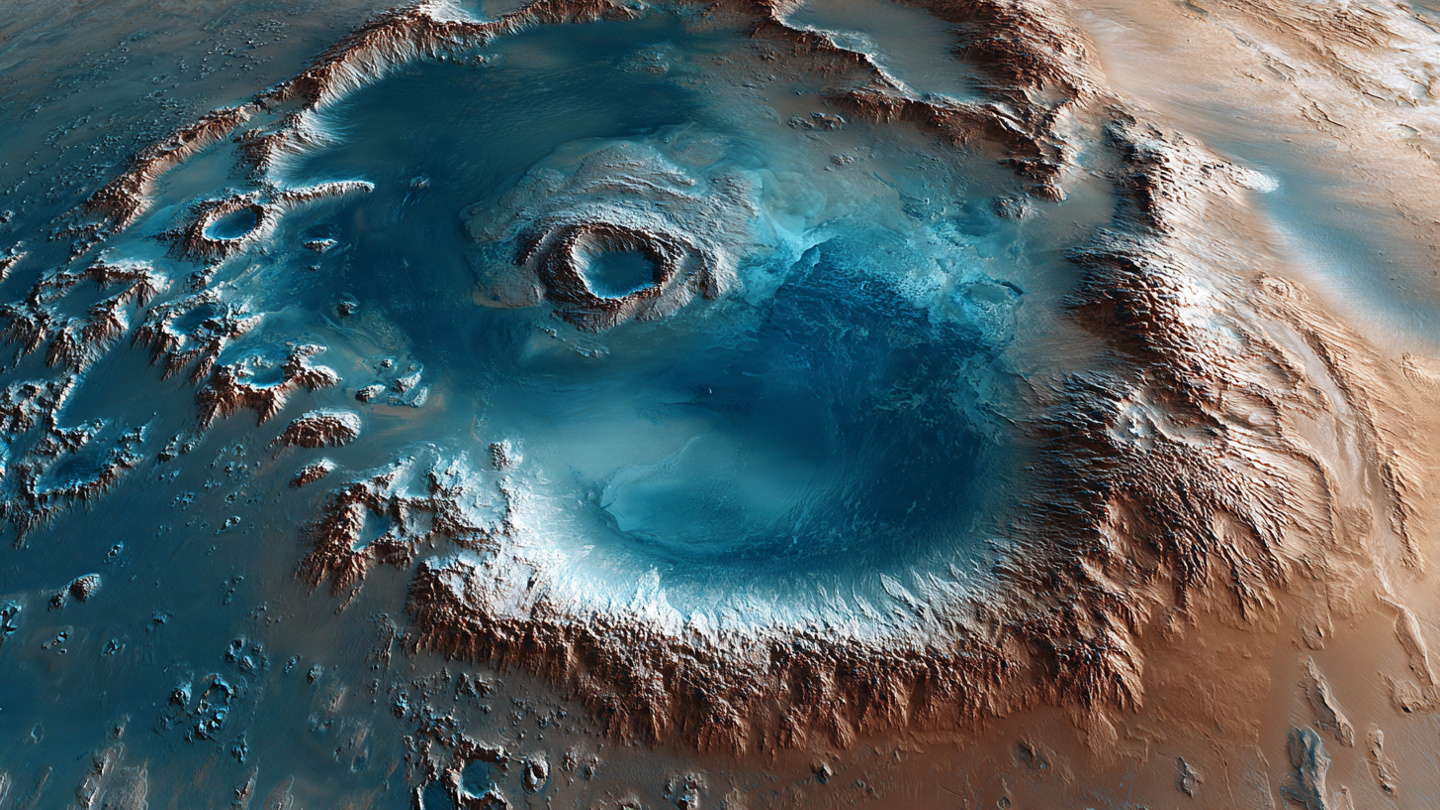
For decades, the story of water on Mars was a tale of extremes: either a “warm and wet” early Eden with vast oceans, or the perpetually frozen, bone-dry desert we see today. This binary narrative is now crumbling under the weight of data from rovers and orbiters. A new, more nuanced and perhaps more compelling chapter is coming into focus. It reveals a Mars that experienced fleeting but recurring “climate windows”—brief periods where the planet thawed just enough to host networks of persistent, cold, icy lakes. This wasn’t a tropical paradise. It was a fragile, slushy, glaciated world where life, if it ever began, would have been clinging to the edge of existence.
The Evidence in the Rocks: Reading a Lake’s Diary
The primary witness to this revised history is the geology of Jezero Crater, the ancient delta now being scoured by NASA’s Perseverance rover. A delta, by its very definition, is the handiwork of a long-lived body of water. You don’t get the layered, sediment-sorted structure of a delta from a single, catastrophic flash flood. You get it from a river patiently feeding a standing lake over thousands of years. Perseverance has seen this story written in the stone: fine-grained clay and mudstones that could only have settled in the quiet, deep waters of a lake bottom, sandwiched between layers of boulders carried by more energetic floods.
But the climate puzzle comes from when this happened. The prevailing evidence suggests the lakes existed not during Mars’ very first billion years, but later, between 3 and 2 billion years ago. This was a time when the Martian atmosphere was already thin, and global average temperatures were far below freezing. So how could liquid water persist?
The Icy Lake Model: A Cold, Thin Solution
The answer lies in moving beyond our Earth-centric view of lakes. The new model proposes that these were not open, sun-drenched lakes like Tahoe or Superior. Instead, they were likely subglacial or ice-covered lakes, akin to those found under the Antarctic ice sheet today.
Here’s how it would have worked: During specific “climate windows,” slight tilts in Mars’ orbit (its obliquity) or increased volcanic activity could have pumped enough greenhouse gases—like carbon dioxide or methane—into the thinning atmosphere to cause a modest, regional warming. This wouldn’t melt the planet wholesale. Instead, it might melt the base of expansive glaciers or regional ice sheets. Meltwater would pool in topographical depressions like craters, protected from immediate evaporation by a thick, insulating lid of ice. This ice cover would create a stable microenvironment, allowing the lake to persist for millennia, even while the broader landscape remained frozen.
In this scenario, the lake is a dim, cold, and pressurized place. Sunlight, if it penetrates the ice at all, would be a faint glow. The water would be near freezing, possibly saline to lower its freezing point further. It is a harsh niche, but a profoundly important one. On Earth, subglacial lakes like Lake Vostok are considered prime targets in the search for ancient microbial life, isolated and preserved for eons.
The Climate Window Mechanism: A Flickering Pulse
What could trigger these intermittent thaws? Planetary scientists point to two primary drivers:
- Orbital Forcing (Milankovitch Cycles on Steroids): Mars’ tilt on its axis is wildly unstable compared to Earth’s. It can oscillate from a gentle 15 degrees to a drastic 45 degrees over hundreds of thousands of years. During periods of high tilt, the polar ice caps receive more direct sunlight and can sublimate, dumping water vapor and volatiles into the atmosphere. This can temporarily thicken the atmosphere, enhance greenhouse warming, and kick-start a glacial melt cycle. The climate window opens, lakes form, then, as the tilt changes again, it slams shut, and the lakes freeze solid or sublime away.
- Episodic Volcanism: While not the global feature it once was, Mars likely experienced late-stage, regional volcanic eruptions. A significant eruption could have belched enormous amounts of greenhouse gases and water vapor into the atmosphere in a geologically short time. This pulse could create a short-lived (perhaps tens of thousands of years) warming spike—just long enough to generate meltwater and fill lake basins before the heat dissipated and the gases were lost to space.
Implications for Life: A Refuge in the Ice
This revised view fundamentally shifts the astrobiological strategy. The search is no longer for the fossils of a primordial, warm ocean. It is now a hunt for signatures of life that could have survived in cold, isolated, ice-bound refuges. The fine mudstones at the bottom of Jezero’s ancient lake are the perfect material to preserve such subtle biosignatures—the chemical or microscopic traces of microbial mats that might have eked out an existence on the dim lake floor, feeding on minerals (chemosynthesis) rather than sunlight.
The “icy lake” model presents a vision of Mars that is both more alien and more tantalizingly familiar. It was a world not of endless summer, but of episodic thaw—a planet that flickered in and out of habitability. Its most enduring bodies of water were not sprawling oceans, but hidden, glacial lakes, clinging to existence under a shell of ice during rare moments of climatic grace. As Perseverance carefully caches samples from this very environment for future return to Earth, we are collecting pieces of a diary from one of these fragile climate windows, hoping to read whether, in the cold and the quiet, anything ever stirred.