
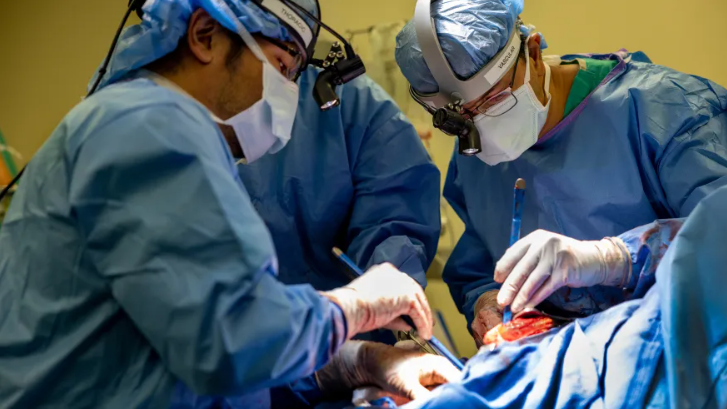
n a moment that feels ripped straight from the pages of medical science fiction, doctors in Chicago achieved something once thought nearly impossible: they kept a patient alive for 48 hours without functioning lungs. No breathing. No oxygen exchange through lung tissue. Yet—life continued.
This extraordinary feat has stunned the global medical community and ignited new hope for patients with severe lung failure. It’s not just a story of cutting-edge technology; it’s a story of human ingenuity, teamwork, and the relentless drive to push medicine beyond its known limits.
So how did this happen? Why does it matter? And what could this mean for the future of critical care and organ transplantation? Let’s break it down.
The Medical Emergency That Changed Everything
The patient, whose identity remains protected for privacy reasons, was suffering from catastrophic lung failure. Traditional treatments had failed. Mechanical ventilation—often the last line of defense—was no longer effective.
In most cases, this scenario leaves doctors with only one option: an immediate lung transplant. But suitable donor lungs are rare, and time is often the enemy.
With the patient’s lungs no longer capable of sustaining life and no immediate donor available, Chicago doctors faced a brutal reality: either attempt the unthinkable or lose the patient.
They chose to attempt the unthinkable.
Living Without Lungs: How Is That Even Possible?
At the heart of this medical miracle was a highly advanced life-support system known as ECMO—Extracorporeal Membrane Oxygenation.
Think of ECMO as a temporary artificial heart-lung machine.
How ECMO Works
- Blood is diverted outside the body
- Oxygen is added artificially
- Carbon dioxide is removed
- Oxygen-rich blood is returned to the body
In most cases, ECMO supports failing lungs or hearts while they recover. But in this case, doctors took a bold step further.
Complete Lung Bypass
The patient’s lungs were effectively taken out of the equation. ECMO handled 100% of oxygenation and circulation duties, allowing doctors to stabilize the patient while buying precious time.
For 48 hours, the patient lived—without using their lungs at all.
Why 48 Hours Matters So Much
You might wonder: Why is 48 hours such a big deal?
In critical care medicine, hours can mean the difference between life and death. Extending survival without lungs for two full days:
- Allowed inflammation and infection to be controlled
- Prevented further organ damage
- Created a window to secure a lung transplant
- Gave the medical team time to strategize instead of rushing risky decisions
This wasn’t just life support—it was time support, and time saved a life.
The Role of Multidisciplinary Teamwork
This achievement wasn’t the result of one brilliant doctor. It was a symphony of expertise working in perfect coordination.
The Team Included
- Cardiothoracic surgeons
- Pulmonologists
- Critical care specialists
- ECMO technicians
- Nurses trained in advanced life support
- Infectious disease experts
Every decision had to be precise. A single miscalculation—blood clotting, oxygen imbalance, infection—could have ended everything.
This level of teamwork highlights an often-overlooked truth: modern medical miracles are built by teams, not individuals.
A Bridge to Transplant, Not a Replacement
It’s important to clarify something: this procedure does not eliminate the need for lungs.
Instead, it acts as a bridge to transplant.
In this case, the 48-hour lung-free survival gave doctors the chance to:
- Locate suitable donor lungs
- Prepare the patient’s body for transplantation
- Reduce inflammation and stabilize vital organs
Eventually, the patient received a lung transplant and continued recovery under close supervision.
Why This Breakthrough Is a Big Deal for Medicine
This case represents more than a single saved life—it opens doors.
1. Expanding the Limits of Critical Care
Doctors now know it’s possible to sustain life longer than previously thought in extreme lung failure cases.
2. Better Outcomes for Transplant Patients
By stabilizing patients instead of rushing into transplants, outcomes can improve significantly.
3. New Hope for ARDS and Severe Infections
Patients suffering from:
- Acute Respiratory Distress Syndrome (ARDS)
- Severe pneumonia
- Viral lung damage
may benefit from similar approaches in the future.
4. Advancing Artificial Organ Research
This case fuels momentum toward:
- Artificial lungs
- Longer-term external oxygenation systems
- Bioengineered organs
The Ethical and Medical Challenges Ahead
As inspiring as this story is, it raises serious questions.
Who Gets Access?
ECMO is expensive and resource-intensive. Not every hospital has the technology or trained staff.
How Long Is Too Long?
Keeping someone alive without a vital organ challenges traditional definitions of life support and recovery limits.
Risk vs Reward
Long ECMO use increases risks of:
- Blood clots
- Infections
- Organ damage
Doctors must carefully balance hope with realism.
A Glimpse Into the Future of Medicine
This achievement hints at a future where:
- Organ failure isn’t an immediate death sentence
- Time can be engineered medically
- Transplant waiting lists become less deadly
It’s like medicine has learned how to pause the clock, even if just for a little while.
And sometimes, a little while is all a patient needs.
Conclusion
The story of Chicago doctors keeping a patient alive for 48 hours without lungs is more than a headline—it’s a milestone.
It proves that with innovation, courage, and teamwork, medicine can push past boundaries once thought immovable. While this technique won’t become routine overnight, its success reshapes what’s possible in emergency and transplant medicine.
In the end, this wasn’t just about machines replacing organs.
It was about giving life a second chance when time had nearly run out.