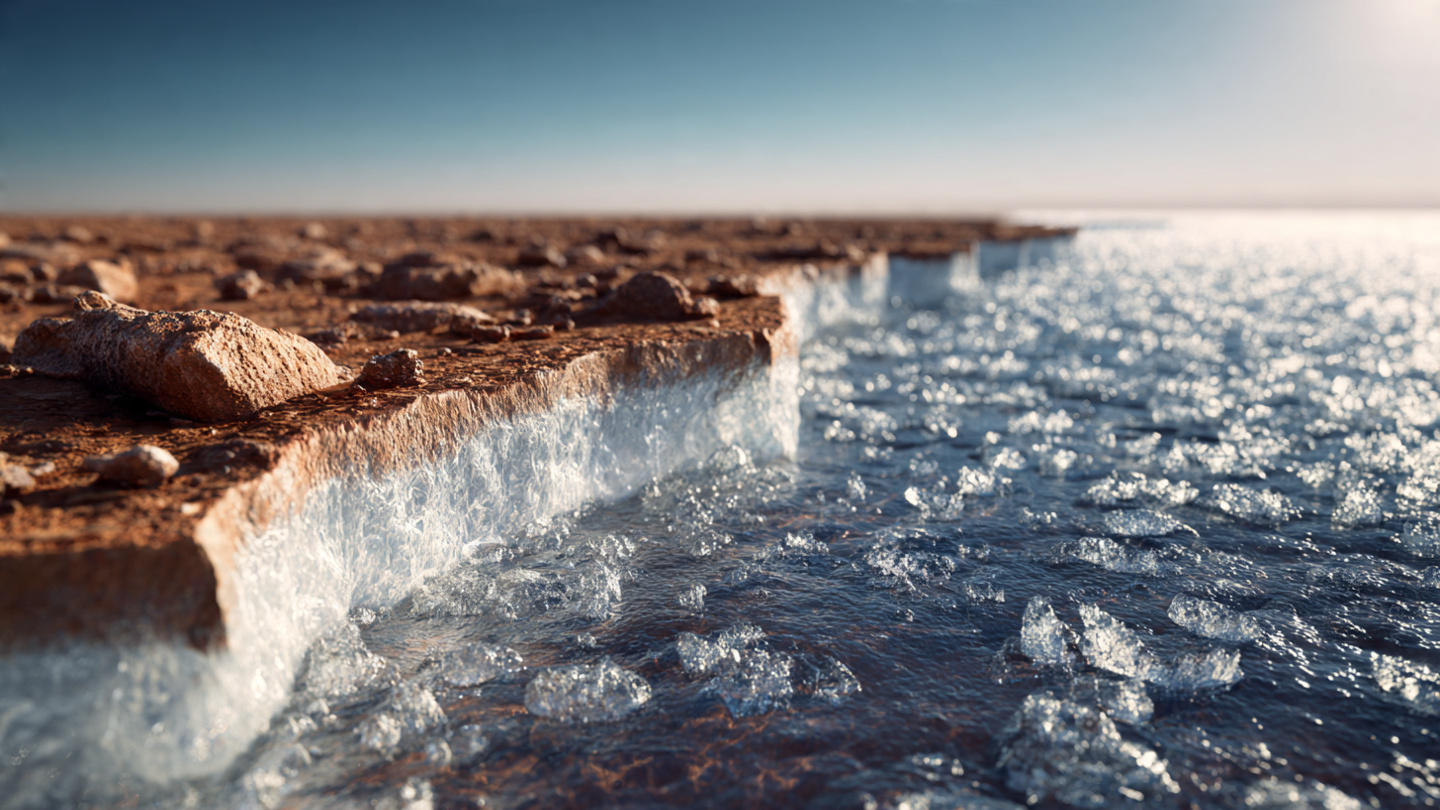
For decades, one question has taunted planetary scientists more than any other about Mars: where did all the water go? The evidence for its past is carved into the planet’s face—vast, dried-up river valleys, sprawling sedimentary deltas, and minerals that only form in liquid water. Yet the modern Martian surface is a desiccated, frozen desert. The leading theory held that most of it escaped into space, lost forever as solar radiation stripped away a thicker atmosphere. But the numbers never quite added up; models suggested this process couldn’t account for all the missing water. Now, a groundbreaking piece of research has cracked the case wide open, pointing not to the heavens, but to the ground. The answer, it turns out, was hiding in plain sight, trapped in a pervasive, thin, and profoundly important layer of dusty ice.
The Case of the Missing Ocean
Billions of years ago, Mars was a different world. It’s believed an ocean of liquid water, perhaps a mile deep in places, covered much of its northern hemisphere. Fast-forward to today, and if that water were all still present as ice, it would blanket the planet in a global layer over 300 feet thick. But we don’t see that. Orbiting spectrometers and surface rovers have found some water ice, locked in polar caps and buried glaciers, but these are mere fractions of the total volume that should be there. This discrepancy is the “Mars water mystery”—a multi-billion-gallon case of cosmic missing person’s report.
A New Suspect: The “Stealth” Ice of the Mid-Latitudes
The breakthrough came from looking at Mars not just as a globe, but as a layered cake. Scientists, synthesizing decades of data from orbiters like NASA’s Mars Reconnaissance Orbiter (MRO) and the ESA’s Mars Express, focused on the planet’s vast, dusty mid-latitudes. These regions are not the bright, white polar caps, but the rusty, seemingly dry plains.
Beneath a few feet of dry red regolith, radar data has long hinted at something strange. The signals suggested a layer with properties consistent with ice, but it was mixed with immense amounts of dust and soil—up to 90% debris by volume. This wasn’t the pristine, blue-veined ice of a glacier; it was a dirty, “pore-filling” ice, like a cosmic sponge cake soaked in water and then frozen solid. For years, this layer was considered a minor footnote, a bit player in the water story. The new research has dramatically revised that role.
The Key to the Lock: A Radical New Accounting
The scientific team did a new inventory. Instead of hunting for pure ice deposits, they modeled how much of this “dirty ice” could be hidden in the upper few hundred meters of Mars’s crust across its entire middle latitudes. The results were staggering.
They concluded that this unassuming, dusty-frosty layer is not a curiosity—it is the dominant water reservoir on modern Mars. It holds more water than is locked in both polar caps combined, and likely represents between 30% to an astonishing 90% of all the water thought to have been lost from that ancient ocean. It has been there all along, not lost to space, but absorbed. Billions of years ago, as the Martian climate cooled and its atmosphere thinned, water vapor from the dying oceans and rivers condensed and percolated into the thirsty, porous ground. There, it froze into a permanent, globe-spanning layer of permafrost, armoured from evaporation by a protective blanket of dust and rock.
Why We Missed It: The Dusty Disguise
This ice remained a mystery for so long because of its brilliant disguise. From orbit, spectrometers looking for the chemical signature of clean water ice saw mostly dust. Ground-penetrating radar saw a confusing mix. Surface features don’t show clean, exposed ice cliffs, but subtle textures and “polygon” terrain—cracked patterns that form in cold regions with underground ice on Earth. We were looking for glittering glaciers and missed the frozen sponge.
The implications of this discovery are profound. First, it rewrites Mars’s climatic history. The planet didn’t necessarily lose all its water; a huge portion was sequestered. This suggests its transition to a cold desert may have been more about internal planetary plumbing than catastrophic atmospheric loss.
Second, it transforms the astrobiological search. This ice layer is a deep-freeze time capsule, potentially preserving traces of any ancient microbial life that existed when liquid water flowed. It is also far more accessible than deep polar deposits. Future human explorers or robotic missions in the mid-latitudes could literally dig for water with a shovel, using it for life support and fuel.
A Paradigm Shift Underfoot
The solution to the great Martian water mystery is a lesson in scientific humility. The water wasn’t gone; it was merely hidden in the most obvious of places—the very ground. Mars didn’t bleed its ocean into the void; it drank it, storing it as a planet-wide layer of dirty frost just beneath our rovers’ wheels. This discovery redefines Mars as a world not of total desiccation, but of profound cold storage. It shifts our focus from a planet that lost its water to one that is still profoundly wet, its greatest treasure buried in a shy, dusty layer of ice, waiting just below the rust-colored surface.
Leave a Reply