
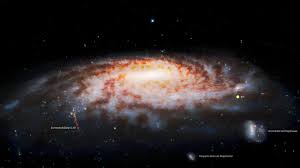
The universe continues to surprise us with hidden structures and cosmic mysteries. In a groundbreaking discovery, astronomers have identified a vast network of stellar streams at the outer edges of the Milky Way, offering new insights into how galaxies evolve over time.
These stellar streams—essentially trails of stars—act like cosmic fossils, preserving the history of galactic mergers and interactions. This exciting discovery is reshaping our understanding of the Milky Way’s formation and its dynamic past.
In this SEO-optimized, in-depth article, we will explore what stellar streams are, how they were discovered, why they matter, and what they reveal about the future of our galaxy.
What Are Stellar Streams?
Stellar streams are long, thin structures made up of stars that have been gravitationally stretched and pulled apart from star clusters or dwarf galaxies.
How Stellar Streams Form
- A smaller galaxy or star cluster gets too close to a larger galaxy
- Gravitational forces tear it apart
- Stars spread out into elongated streams
These streams can stretch across thousands of light-years, forming intricate patterns around galaxies.
The New Discovery: A Hidden Web of Stars
Astronomers have recently detected a large number of previously unknown stellar streams at the outskirts of the Milky Way.
Key Highlights of the Discovery
- Dozens of new stellar streams identified
- Located in the galaxy’s outer halo
- Revealed using advanced sky surveys and data analysis
- Provides clues about past galactic collisions
This discovery highlights how much of our galaxy remains unexplored and hidden.
How Astronomers Made the Discovery
Modern technology played a crucial role in uncovering these stellar streams.
Advanced Telescopes and Data
Researchers used data from powerful observatories like European Space Agency missions and ground-based telescopes.
Role of Space Missions
One of the most important contributors is the Gaia mission, which maps billions of stars with incredible precision.
Data Analysis Techniques
- Machine learning algorithms
- High-resolution imaging
- Stellar motion tracking
These tools allow scientists to detect faint and distant structures that were previously invisible.
Why Stellar Streams Matter
Stellar streams are not just beautiful—they are scientifically invaluable.
Clues to Galactic History
- Reveal past mergers with smaller galaxies
- Show how the Milky Way grew over time
- Help reconstruct the galaxy’s timeline
Understanding Dark Matter
Stellar streams are influenced by dark matter, the invisible substance that makes up most of the universe’s mass.
- Their shapes can reveal dark matter distribution
- Help scientists map unseen structures
The Role of Galactic Collisions
The Milky Way has not always been a calm, stable galaxy.
A Violent Past
- Smaller galaxies have collided with and merged into the Milky Way
- These events leave behind stellar streams
H3: Ongoing Interactions
The Sagittarius Dwarf Galaxy is currently being torn apart, creating one of the most well-known stellar streams.
What This Discovery Reveals About the Milky Way
A More Complex Structure
The Milky Way is not just a simple spiral galaxy—it has:
- A dynamic outer halo
- Hidden structures
- Ongoing interactions
H3: Continuous Evolution
This discovery shows that our galaxy is still evolving, shaped by gravitational forces and cosmic events.
The Science Behind Stellar Streams
Gravitational Forces
Gravity plays the central role in forming and shaping stellar streams.
Orbital Motion
Stars in streams follow predictable paths, allowing astronomers to:
- Trace their origins
- Predict future movement
H3: Tidal Forces
These forces stretch and distort star clusters, creating the stream-like appearance.
Future Research and Exploration
The discovery of multiple stellar streams opens new avenues for research.
Upcoming Missions
Future missions will provide even more detailed data on the Milky Way.
Improved Mapping Techniques
- Higher-resolution imaging
- Advanced AI analysis
- Deeper space observations
Potential Discoveries
- New stellar streams
- Hidden dwarf galaxies
- Better understanding of dark matter
Impact on Astronomy and Science
H3: Advancing Galactic Science
This discovery helps scientists:
- Understand galaxy formation
- Study cosmic evolution
- Improve astrophysical models
Educational Importance
- Inspires students and researchers
- Expands knowledge of the universe
Actionable Insights for Readers and Bloggers
For Science Enthusiasts
- Follow updates from space agencies
- Learn about astrophysics and cosmology
For Students
- Explore careers in astronomy
- Study physics and mathematics
For Bloggers (SEO Opportunities)
Target keywords like:
- “Milky Way discovery 2026”
- “stellar streams explained”
- “galaxy formation secrets”
Create engaging content to attract readers interested in space science.
Key Takeaways
- Astronomers discovered numerous stellar streams at the edge of the Milky Way
- These streams are remnants of past galactic interactions
- They provide insights into dark matter and galaxy formation
- Advanced technology played a key role in the discovery
Conclusion
The discovery of a myriad of stellar streams at the periphery of the Milky Way marks a significant milestone in our understanding of the universe. These celestial structures act as cosmic time capsules, revealing the hidden history of our galaxy and its interactions over billions of years.
As technology continues to advance, we can expect even more discoveries that will deepen our knowledge of the cosmos. For now, this finding reminds us that the universe is far more complex and fascinating than we ever imagined.