
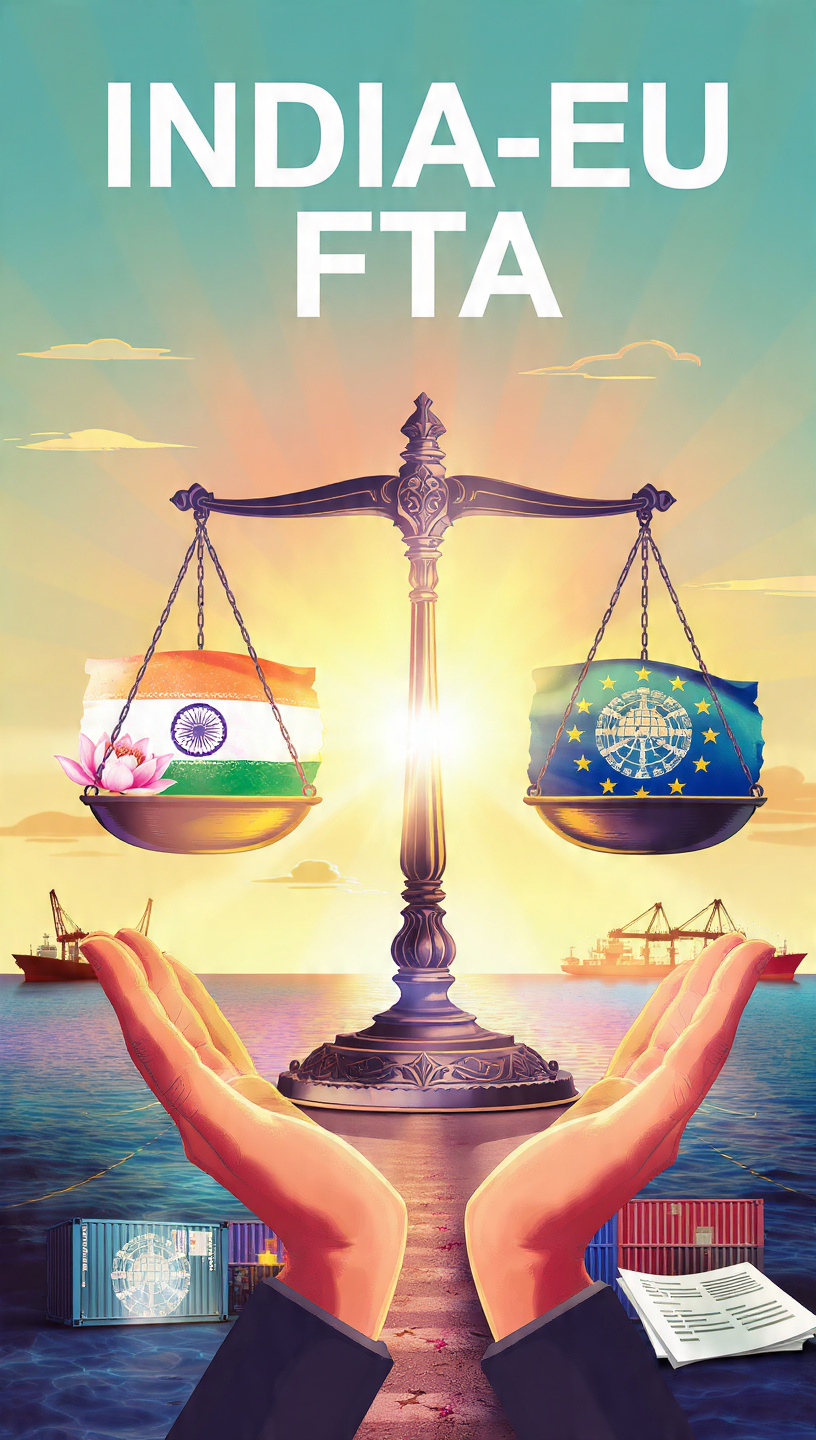
The proposed India–European Union (EU) Free Trade Agreement (FTA) has been widely described as the “mother of all deals”, and for good reason. Bringing together one of the world’s fastest-growing major economies and one of its largest trading blocs, this agreement has the potential to reshape global trade patterns, supply chains, and geopolitical alliances for decades to come.
As negotiations continue, policymakers, businesses, and analysts across the world are watching closely. The deal is not just about lowering tariffs—it represents a strategic partnership that could redefine economic cooperation between Asia and Europe.
Understanding the India-EU Free Trade Agreement
The India-EU Free Trade Agreement, officially referred to as a Broad-based Trade and Investment Agreement (BTIA), aims to deepen economic ties by reducing trade barriers, improving market access, and setting common standards across multiple sectors.
Negotiations first began years ago but faced repeated pauses due to differences over tariffs, labor standards, environmental rules, and intellectual property rights. Recently, however, renewed political will on both sides has brought the talks back to the forefront, with leaders signaling strong commitment to finalizing the deal.
Calling it the “mother of all deals” highlights the scale, complexity, and strategic importance of the agreement.
Why the Deal Matters So Much
The combined economic weight of India and the EU is enormous. Together, they represent:
- Over 1.8 billion people
- Nearly one-quarter of global GDP
- A massive consumer and manufacturing base
An agreement between these two economic giants would influence not just bilateral trade, but also global standards in areas such as sustainability, digital trade, and supply chain resilience.
Key Objectives of the India-EU FTA
The proposed agreement focuses on several core objectives:
- Reducing tariffs on goods and services
- Encouraging foreign direct investment
- Improving regulatory transparency
- Strengthening intellectual property protection
- Promoting sustainable and ethical trade practices
Both sides see the FTA as a long-term partnership rather than a short-term commercial arrangement.
Trade in Goods: Opening New Markets
One of the most visible aspects of the agreement is tariff reduction. India currently applies relatively high tariffs on certain European exports, while EU regulations can limit Indian access in some sectors.
Benefits for India
- Improved access for textiles, pharmaceuticals, chemicals, and agricultural products
- Greater competitiveness for Indian manufacturers
- Increased exports to high-value European markets
Benefits for the EU
- Easier access to India’s growing consumer market
- Reduced tariffs on automobiles, machinery, and luxury goods
- Stronger foothold in one of the world’s fastest-expanding economies
Services and Digital Trade
Services form a major part of both economies. India is a global leader in IT and digital services, while the EU has strong financial, professional, and consulting sectors.
The FTA aims to:
- Ease visa and mobility rules for skilled professionals
- Improve cross-border digital services
- Promote cooperation in fintech, cybersecurity, and e-commerce
As digital trade grows, this part of the agreement could become one of its most impactful components.
Investment and Supply Chain Resilience
In a post-pandemic world marked by geopolitical tensions, supply chain diversification has become a top priority. The India-EU FTA is expected to encourage European companies to invest more heavily in India as an alternative manufacturing hub.
For India, this means:
- Increased foreign direct investment (FDI)
- Job creation across manufacturing and services
- Technology transfer and skill development
For the EU, India offers:
- A stable, democratic partner
- Reduced dependency on single-country supply chains
- Long-term growth opportunities
Sustainability and Climate Commitments
A defining feature of modern trade agreements is their focus on sustainability. The EU, in particular, places strong emphasis on environmental and labor standards.
The India-EU FTA is expected to include:
- Commitments to climate action
- Support for renewable energy collaboration
- Ethical labor practices and worker protections
While these provisions can be challenging to implement, they also position the agreement as a forward-looking model for responsible global trade.
Challenges and Points of Disagreement
Despite the optimism, negotiations have not been easy. Key challenges include:
- Disagreements over agricultural subsidies
- Concerns around data protection and privacy
- Differences in labor and environmental standards
- Market access for sensitive industries
Balancing economic ambition with domestic priorities remains a delicate task for both sides.
Geopolitical Significance of the Deal
Beyond economics, the India-EU FTA carries major geopolitical implications. As global power dynamics shift, both India and the EU are seeking strategic autonomy and stronger partnerships outside traditional alliances.
This agreement signals:
- A shared commitment to multilateralism
- Reduced reliance on unstable trade relationships
- A united stance on rules-based global trade
In many ways, the deal strengthens cooperation between democratic economies in an increasingly fragmented world.
Impact on Small and Medium Enterprises (SMEs)
SMEs stand to gain significantly from the agreement. Reduced tariffs and clearer regulations can help smaller businesses access international markets more easily.
Potential benefits include:
- Lower export costs
- Simplified customs procedures
- Greater participation in global value chains
For both Indian and European SMEs, the FTA could unlock growth opportunities previously limited to large corporations.
Public and Business Sentiment
Business leaders on both sides have largely welcomed the renewed momentum behind the agreement. Industry groups see it as a chance to boost competitiveness, innovation, and long-term growth.
Public opinion is more mixed, with concerns about job protection, environmental impact, and fair competition. Addressing these concerns transparently will be key to ensuring widespread support.
What Happens Next?
Negotiators are working to resolve remaining differences and finalize the framework of the agreement. While timelines remain uncertain, political signals suggest strong determination to move forward.
If concluded, the India-EU FTA would likely be:
- One of the largest trade deals globally
- A benchmark for future international agreements
- A catalyst for deeper India-Europe cooperation
Conclusion
The India-EU Free Trade Agreement truly earns its title as the “mother of all deals.” It is ambitious in scope, strategic in vision, and transformative in potential. More than a trade pact, it represents a partnership between two major global players committed to growth, sustainability, and shared prosperity.
If successfully implemented, the agreement could reshape trade flows, strengthen supply chains, and set new global standards—marking a defining moment in international economic relations.